Design Systems

A professional course

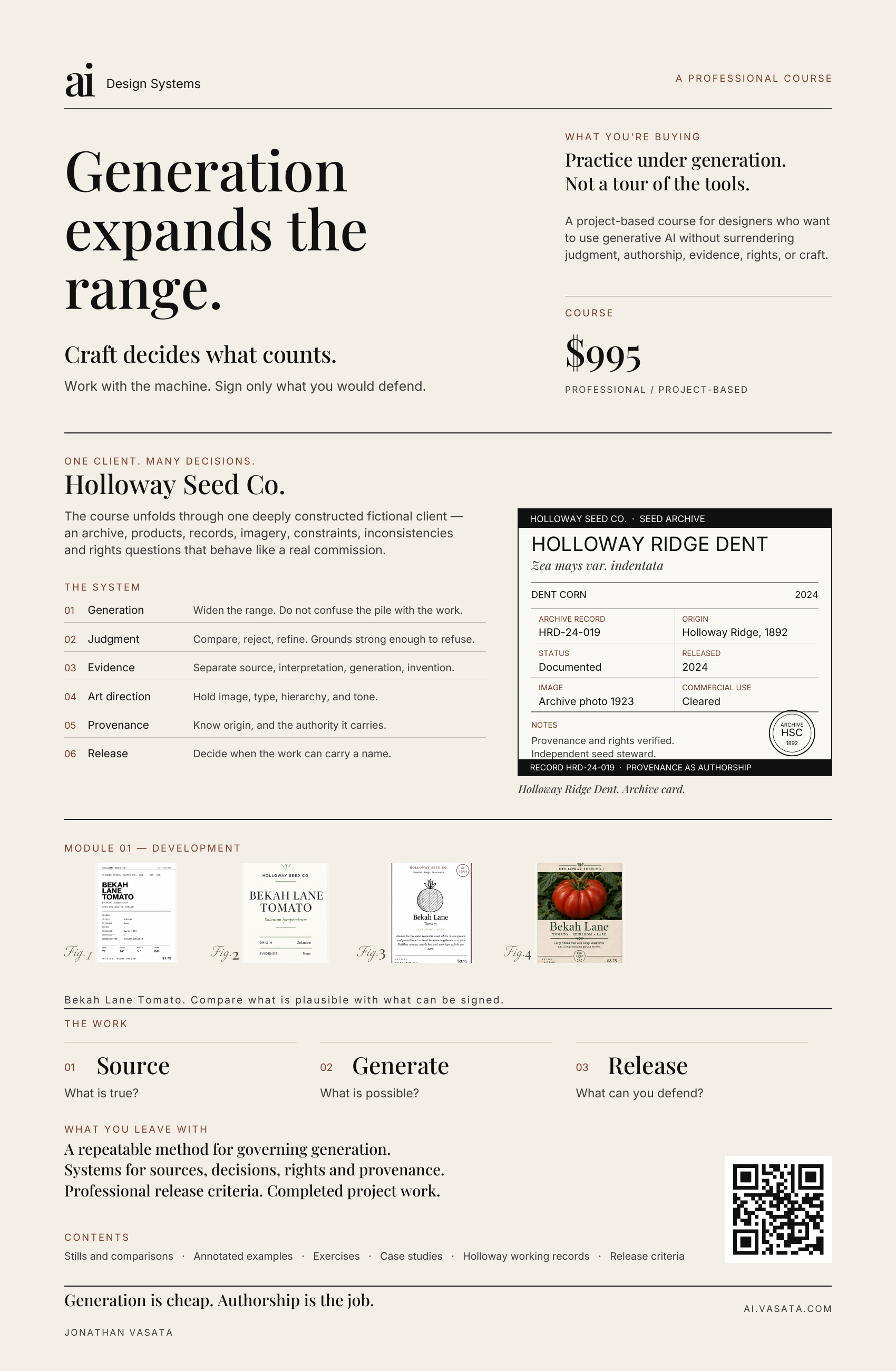
Generation expands the range.

Craft decides what counts.

Work with the machine. Sign only what you would defend.

Enroll — $995 →

Prospectus

Fourteen years inside the production systems behind Time, People, and Sports Illustrated. The signing question is not new.


Who it is for

  • Working designers
  • Creative directors
  • Freelancers and studio owners
  • Advanced students
  • Faculty building a workshop

The course

Practice under generation, not a tour of the tools.

Stills, comparisons, annotated examples, exercises, and case studies. Built for people who already have taste and need a way to keep authorship when generation gets cheap.

  • 01 Stills and comparisons
  • 02 Annotated examples
  • 03 Exercises
  • 04 Case studies

Prospectus

Take the prospectus with you.

A one-page overview of the course, its method, the Holloway working world, and what you leave with.

One-page PDF · save, share, or print

Proof

Generation is cheap. Authorship is the job.

The work is not the four directions. The work is learning why three of them do not get released.

Module 01 — Development

Bekah Lane Tomato development sheet showing four design directions labeled fig. 1 through fig. 4.
Bekah Lane Tomato. One record, four design decisions.

The record shows why it can be trusted.

Module 02 — Record

Holloway Ridge Dent

Holloway Ridge Dent

Zea mays var. indentata

Dent Corn 2024
Archive record HRD-24-019
Origin Holloway Ridge, 1892
Status Documented
Released 2024
Image Archive photo 1923
Commercial use Cleared
Seed Archive
Holloway Ridge Dent. Archive card. Provenance as authorship.

Inside

  1. AI can give you a hundred versions before lunch. That does not mean any of them are yours yet.

    • More options is not the same as better work.Generation makes the pile bigger. Authorship is choosing what leaves the pile.
    • Three different objects: draft, option, work.A draft is exploration. An option is a candidate. Work is what you would put your name on.
    • The machine widens the search. You decide what survives.Cheap generation makes this more important, not less.
    • Signing is the line.If someone asked why this exists, you could answer without hiding behind the tool.
    • If you already use AI:The useful skill is not prompting faster. It is knowing when a fluent output is still only a fragment.
  2. Left alone, the model picks a familiar look. Most of the internet now shares that look.

    • AI has a default voice.Same letter shapes, same confidence, same “close enough.”
    • “Looks fine” is often the failure.Readable type can still be nobody’s decision. That is how generated work starts to feel interchangeable.
    • Type is a choice you can point to.Pairing, size, and hierarchy should be something you could explain.
    • Compare two settings of the same words.One is what the machine offered. One is what you would sign. The gap is the lesson.
    • If you already use AI:If your layouts keep arriving in the same type world, the model is designing the voice.
  3. A layout is not “where things went.” It is what you kept, what you cut, and what you left empty on purpose.

    • The first spread is a suggestion.Treat generated composition as a draft of arrangement, not as the page.
    • Empty space is a claim.If everything is filled, nothing is chosen. Margin is part of the authorship.
    • Sameness is not fairness.Giving every item the same layout can hide incomplete records. Consistency can conceal.
    • Pretty can make a weak page feel settled.An attractive layout is not proof that the content underneath is ready to go out.
    • If you already use AI:Ask what the layout is covering. If the design is doing the convincing, the evidence may be thin.
  4. If you cannot say where something came from, you cannot safely send it out.

    • Four different kinds of “allowed.”Is the fact supported? Is the image cleared? Is the data complete? Is the whole piece cleared to leave the studio?
    • A beautiful page can launder a bad source.Design prestige makes uncertain material feel finished.
    • Don’t invent the missing fact to make the layout work.If the record is incomplete, the honest design shows the gap.
    • One world, not random examples.Holloway Seed Co. is a persistent company so yesterday’s choice still matters tomorrow.
    • If you already use AI:Generated images and copy often arrive with no usable provenance. Fluency is not clearance.
  5. The course lets you make a reasonable-looking decision first. Then it shows you what that decision hid.

    • You meet the failure before you get the rule.Judgment is learned under pressure, not by memorizing a list.
    • Bad work is easy to spot. Dangerous work looks fine.The hard cases are attractive, credible, and still indefensible.
    • Finished is not “it looks done.”Finished is: a responsible person can defend releasing it.
    • Revision is the job.Rejected, revised, signed. Empty frames stay empty until there is a real correction.
    • If you already use AI:The model will happily give you a polished wrong answer. The skill is noticing the hidden condition.
  6. When a machine is in the room, someone still has to own the call.

    • Who signs this?Not who typed the prompt. Who is willing to stand behind the object if it goes public.
    • Review the object, not the tool path.How it was generated matters less than whether it can be released.
    • Keep a shared record, not a shared prompt pile.The durable thing is what was decided, cleared, and rejected.
    • A cheaper model does not lower the standard.If the bar only holds when generation is slow, it was never a standard.
    • If you already use AI:Use models to widen the search. Do not let any of them become the authority.
  7. You cannot hand someone a list of tools and call it a course. You hand them rooms they can practice in.

    • Not a tour of software.Tools change. Judgment, evidence, and release responsibility do not age at the same speed.
    • Practice has a finish line.An exercise ends when there is an object with a name on it.
    • Stable principles, living tools.The core stays put. The reference layer can move when the software moves.
    • A classroom can use the same rooms.Faculty and studios can adapt the world and the gates without turning the week into prompt class.
    • If you already use AI:The thing worth teaching is how to refuse a fluent answer. That transfers. The interface does not.

Author

Jonathan Vasata, in profile.

Jonathan Vasata

Photographer · Designer · Educator

MFA in Photography, Savannah College of Art and Design. Chief Photographer of SCADdistrict. Adobe Certified Instructor. Media Solutions Engineer at Time Inc. Publishing Technology Manager at Hearst Magazines, supporting titles including Time, People, Sports Illustrated, Fortune, and Money.

Published internationally and held in private collections worldwide.

Enrollment

Enroll in AI Design Systems

Enrollment is a one-time $995 payment processed securely through Stripe. If you have a student or tester access code, you can apply it at checkout.

Enroll — $995 →

Join the list

Stay in the loop.

Course updates, new sessions, workshops, and notes from the practice.

Programs

Courses, workshops, and curriculum built for real classrooms.

Available for colleges, universities, design programs, studios, and professional teams. Jonathan can develop a complete syllabus, adapt AI Design Systems into a custom course or workshop, teach an intensive or full academic class, or collaborate with faculty and institutions to build new curriculum around AI, design practice, authorship, and production.

Design it. Adapt it. Build it and teach it with you.

Contact

Write Jonathan

Selected publications